Valve Internal Leakage Again? GEKO Reveals Six Major Causes of Valve Sealing Surface Damage
Apr 29, 2026
In industrial systems such as petrochemical, power generation, metallurgy, and pharmaceutical applications, valve internal leakage is a common issue that affects system safety, efficiency, and operational stability. One of the key causes of internal leakage is often damage to the valve sealing surface.
As a brand focused on industrial valves and flow control solutions, GEKO draws on years of application experience to summarize six common causes of valve sealing surface failure, helping users identify problems more accurately, optimize valve selection, and extend service life.
1. Erosion Damage
When the medium contains solid particles, such as catalyst powder, rust, or sand, or when high-speed gas-liquid two-phase flow passes through the valve, the sealing surface is subjected to continuous high-frequency impact. This can cause grooves, pitting, or linear wear on localized areas.
This is especially common under throttling conditions, where flow velocity increases significantly and the sealing surface may be “blown” into radial flow marks by the high-speed fluid. A typical sign is obvious linear erosion along the direction of medium flow.
GEKO Reminder: For media containing particles, high-flow velocity, or erosive conditions, sealing materials and structural designs with stronger erosion resistance should be prioritized.
2. Plastic Deformation and Indentation Caused by Contact Stress
At the moment a valve closes, the sealing surface is subjected to extremely high contact pressure. If the material hardness is insufficient or the closing force is excessive, plastic deformation may occur on the sealing surface.
Soft materials are prone to surface dents, while hard materials may suffer localized spalling. After repeated opening and closing over time, the surface layer of the sealing surface may gradually undergo “work hardening,” which can induce microcracks and eventually develop into delamination failure.
GEKO Recommendation: For high-frequency operation or high-pressure-difference applications, attention should be paid to the hardness matching of the sealing pair and the control of closing force to avoid premature sealing surface failure caused by overload.
3. Creep and Softening at High Temperatures
In high-temperature pipelines such as steam or thermal oil systems, valve sealing surface materials may experience two types of harmful changes.
On one hand, high temperature can soften the material, reduce hardness, and weaken its resistance to scratching and wear. On the other hand, under continuous pressure, the sealing surface may undergo creep deformation, damaging the precise sealing profile.
In addition, high temperatures accelerate the formation of oxide scale. Once the oxide layer peels off and enters the sealing pair, it further intensifies friction and wear.
GEKO Reminder: For high-temperature applications, valve selection should focus on the material’s high-temperature strength, oxidation resistance, and sealing stability.
4. Electrochemical Corrosion and Crevice Corrosion
When different metallic materials are used in the sealing pair, such as a stainless steel valve seat combined with a Stellite alloy hard-faced sealing surface, a galvanic cell may form in an electrolyte medium, leading to electrochemical corrosion.
More importantly, tiny crevices can form between sealing surfaces after the valve is closed. The medium may stagnate inside these crevices, creating oxygen concentration differences and causing localized corrosion, deep pits, or corrosion holes. If chloride ions are present, stainless steel sealing surfaces may also suffer stress corrosion cracking.
GEKO Recommendation: For corrosive media, the medium composition, temperature, concentration, and material compatibility should be comprehensively evaluated to select a more suitable anti-corrosion sealing solution.
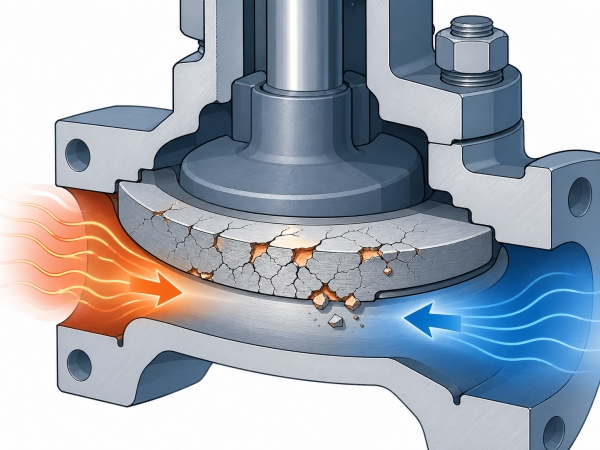
5. Cracking and Spalling Caused by Thermal Shock
Valves that open and close frequently and rapidly, such as program-controlled valves and safety valves, often experience repeated thermal shock on the sealing surface.
Because the surface temperature changes faster than the base material, cyclic thermal stress can occur. When the stress exceeds the fatigue limit of the material, mesh-like thermal fatigue cracks may gradually appear on the surface. As the cracks continue to expand and connect with each other, localized spalling may occur, forming a “crazed” or “turtle-shell” failure pattern.
GEKO Reminder: For applications with large temperature fluctuations and frequent operation, valve sealing materials and structures with better thermal fatigue resistance should be selected.
6. Accelerated Corrosion Caused by Medium Retention Between Sealing Surfaces
When a valve remains partially open, slightly leaking, or poorly sealed for a long period, the high-pressure side medium continuously washes the sealing surface, while corrosive media may stagnate on the low-pressure side.
In the stagnant area, changes in pH value, ion concentration, and accumulation of corrosion products can significantly accelerate localized corrosion. The corrosion rate may even be several times higher than under normal flowing conditions, eventually forming local pits that can quickly penetrate the sealing surface.
GEKO Recommendation: During valve operation, long-term throttling in a partially open position or operation with existing leakage should be avoided. Regular inspection of sealing performance and timely treatment of minor internal leakage can prevent small issues from developing into serious failures.
GEKO Conclusion
Valve sealing surface damage is rarely caused by a single factor. In most cases, it results from the combined effects of erosion, wear, corrosion, high temperature, thermal shock, and operating conditions.
Choosing the right valve requires more than simply considering pressure rating and size. Medium characteristics, temperature range, operating frequency, pressure differential, and corrosion risk should all be evaluated comprehensively.
GEKO is committed to providing reliable, efficient, and application-specific valve solutions for industrial users, helping customers reduce internal leakage risks and improve system safety and operational stability. Contact us for more!
Read More






 Email : info@geko-union.com
 Email : info@geko-valves.de
 Email : tw@geko-union.com
 Email : nl@geko-union.com



 IPv6 network supported