Types of Specialized Industrial Ball Valves for Unique Piping Applications | GEKO Valve
Aug 04, 2026
Types of Specialized Industrial Ball Valves for Unique Piping Applications
Standard industrial ball valves provide reliable on/off shut-off performance for most general piping systems. However, many industrial processes including flow modulation, sanitary production, cryogenic fluid handling, and multi-path fluid switching require specialized ball valve designs to meet unique operating demands. General-purpose floating and trunnion ball valves cannot solve complex process problems such as precise regulation, contamination prevention, ultra-low temperature resistance, and medium diversion. This article introduces four widely used special-type ball valves, covering their structural features, working principles, advantages, and typical industrial applications to help engineers select the correct valve for special piping scenarios.
1. V-Port Ball Valve (Variable Flow Control Ball Valve)
A V-port ball valve is a specialized regulating ball valve designed for precise flow modulation. Different from standard round-hole ball valves, its ball core is machined with a V-shaped notch that provides an approximately linear flow characteristic throughout the entire stroke. When the valve opens and closes, the V-shaped cutting edge shears fluid medium smoothly, making it ideal for viscous liquid, fiber-containing medium, and accurate flow adjustment.
Key Advantages
- Precise 0–100% proportional flow regulation
- Excellent linear flow curve for PID automatic control systems
- Self-cleaning shear function prevents fiber and particle blockage
- Zero leakage shut-off performance
Typical Applications: Chemical processing, papermaking industry, wastewater treatment, oil and grease pipelines, and automatic process flow control systems.
2. Multi-Way Ball Valve (3-Way & 4-Way Ball Valve)
Multi-way ball valves include 3-way and 4-way structural designs, developed to replace complex pipeline tee joints and multiple valve combinations. They are used to realize fluid diversion, mixing, direction switching, and loop control within a single valve unit, greatly simplifying piping layout and reducing system installation costs.
Key Advantages
- Integrated fluid switching and mixing function
- Simplifies pipeline structure and reduces leakage points
- Supports flexible flow direction switching for skid systems
- Compact structure, easy for modular equipment integration
Typical Applications: Industrial skid-mounted equipment, heating circulation systems, petrochemical fluid switching, HVAC systems, and process medium mixing pipelines.
3. Sanitary Ball Valve (Food Grade Ball Valve)
Sanitary ball valves are specially designed for sterile and contamination-free production environments. The entire valve body adopts full mirror polishing treatment with no internal dead corners, no residue accumulation, and smooth fluid passage. Most sanitary ball valves adopt quick clamp connection for fast disassembly and on-site cleaning, fully meeting GMP production standards.
Key Advantages
- Dead-free internal cavity to avoid bacterial growth
- High-precision mirror polishing surface
- Food-grade sealing materials available
- Easy disassembly, cleaning, and sterilization
Typical Applications: Food processing, beverage production, pharmaceutical industry, biological engineering, and cosmetic manufacturing pipelines.
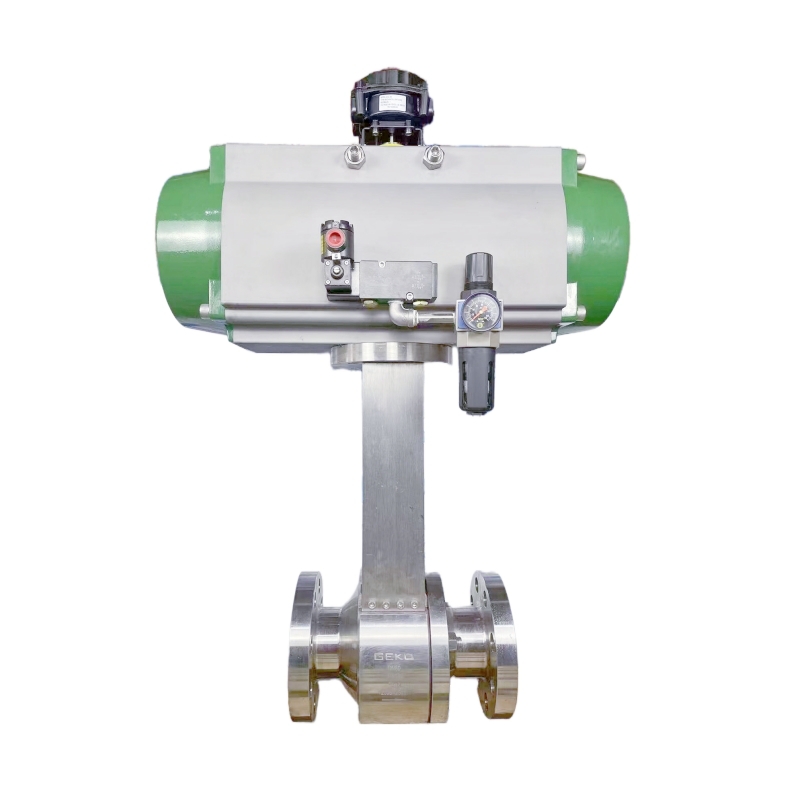
4. Cryogenic Ball Valve (Low-Temperature Ball Valve)
Cryogenic ball valves are professional low-temperature resistant valves developed for ultra-low temperature fluid working conditions. Equipped with an extended bonnet structure, the valve isolates low-temperature fluid from packing components, preventing packing failure and frost cracking under extreme low temperature. Special low-temperature resistant materials ensure stable sealing and mechanical performance in cryogenic environments.
Key Advantages
- Extended stem bonnet protects sealing components from low-temperature frost damage
- Professional cryogenic material configuration maintains toughness at ultra-low temperature
- Stable sealing performance for long-term low-temperature operation
- Anti-static and fire-safe optional design
Typical Applications: LNG transmission stations, liquid nitrogen and liquid oxygen pipelines, cryogenic chemical storage systems, and low-temperature energy equipment.
How to Select Specialized Ball Valves for Industrial Systems
Standard ball valves can only complete simple on/off cut-off functions. For special industrial processes requiring flow regulation, sterile transportation, low-temperature medium delivery, and multi-path fluid switching, selecting matched specialized ball valves is essential to avoid pipeline blockage, medium contamination, control inaccuracy, and valve failure.
Engineers should select valve types according to medium characteristics, operating temperature, control requirements, and industry standards. V-port valves for regulation, multi-way valves for flow switching, sanitary valves for sterile industries, and cryogenic valves for ultra-low temperature systems.
Conclusion
Specialized ball valves play an irreplaceable role in complex industrial piping systems. Each type of special ball valve is developed for specific process pain points, providing higher precision, stronger environmental adaptability, and safer operation than ordinary ball valves. GEKO Valve provides a full range of customized special ball valves including V-port regulating ball valves, multi-way switching ball valves, sanitary food-grade ball valves, and cryogenic low-temperature ball valves, supporting diversified industrial process system solutions.
Read More






 Email : info@geko-union.com
 Email : info@geko-valves.de
 Email : tw@geko-union.com
 Email : nl@geko-union.com



 IPv6 network supported